*But only if male, cisgendered, and white.
[It's been a while since I last posted and I have no excuse. I'll sum it up as LIFE and leave it at that.]
Instead, here's what I want to talk about: The Chosen One trope.
It occurred to me today that often, when this trope is used in a story, it refers to a male protagonist. Usually young (10-18), always--as far as I can recall--heterosexual cis-gendered, and frankly, usually white.
The kid learns that their normal life is a fraud/to keep them safe/about to change irreversibly, and they have been chosen to defeat a great evil. Harry Potter was far from the first, and nowhere near the last.
It's not to say girls/women can't be protagonists or heroes, but more often, they seem thrust into the role through circumstances. Katniss just wants to protect her little sister. Sabriel just wants to find her father.
What I do find more is the role of female protagonist as "Not like the other girls." You see it a lot in romantic comedies. Debra Messing's character, Cat, from The Wedding Date: not the first woman to hire Dermot Mulroney as a date, but the first to make him fall in love. Katherine Heigl's Jane in 27 Dresses is like many women in her love for weddings and desire to help friends, but she's the only person to make James Marsden's Kevin see the love and romance is weddings and marriages.
It feels like a way to simplify their characters. Why, out of all the other women these men meet, are these the ones who get through to them? Why, they aren't like other women! Of course! How aren't they like other women? Uh, well, they sing? You know what? Just trust us on this.
But that's not the only place. You can find the trope in fantasy books as well, but they take a different approach.
Alanna is the only girl who wants to be a knight in Tortall and poses as a boy to do it, and later, Kel is the first girl to become a knight since it was allowed through royal decree. Daine, in the same world, is the only Wild Mage. October Daye is a changeling who has one foot in the fae world and one in the human world, the first person to really befriend the Luidaeg, who doesn't like anyone. Cat and Beatrice in Cold Magic have their own special (slightly spoilery so I won't mention specifics) traits that set them apart from everyone else in their community.
But rather than being called Chosen Ones, and beyond their special something that separates them from other women, they are heroines through the choices they make and the circumstances of society around them.
It makes all of these characters even more complicated--sometimes they make the wrong choices and have to deal with those consequences. Sometimes they want to do one thing, but the rest of the world is working against them because other forces have their own motivations and goals. The characters are complex and the worlds are complex.
On the one hand, it'd be nice to see more female Chosen Ones. But maybe the answer is more to get rid of the Chosen One trope for males. One of the fan theories (almost canon? actually canon?) that's always intrigued me is the idea that Neville could have been the Boy Who Lived. He was born around the same time, his parents suffered because of Voldemort, and if Voldemort had thought it was him and gone after his family, the books might have turned out differently in some very interesting ways. It was a self-fulfilling prophecy in terms of the villains choices, but how could it have been different if there wasn't the label of Chosen One hanging over Harry's head?
Anyway, those are my thoughts today. I'll try not to wait so long to post again.
Books/Series referenced:
Harry Potter: The Harry Potter series by J. K. Rowling
Katniss: The Hunger Games by Suzanne Collins
Sabriel: Sabriel/Abhorsen by Garth Nix
Alanna: The Lioness Quartet by Tamora Pierce
Kel: Protector of the Small series by Tamora Pierce
Daine: The Immortals Quartet by Tamora Pierce
October Daye: The October Daye series by Seanan McGuire
Cat and Beatrice: The Spiritwalker Trilogy by Kate Elliott
Showing posts with label gender. Show all posts
Showing posts with label gender. Show all posts
Sunday, December 7, 2014


Friday, August 10, 2012
Demystifying Books
I read an article a few days ago, mentally sputtering as I went through it (if I was actually sputtering, the coworkers around me—I was on break, eating lunch—would probably have looked at me funny). At the time, I couldn't really get past a few key quotes to speak on it analytically, but with a few days' worth of separation, let's see what comes up.
[A note before we begin: I don't really like using "boy" and "girl" to describe teens and above, but in this case, it's used for the sake of easy understanding. Figure when I use either, I am referring to preteens and teens, middle grade and YA readers.]
First off, the article was called "Boys and Reading: Is There Any Hope?" from The New York Times online. [Answer: Yes, of course there is. And I'm a pessimist saying so.] The article was about the current "trend" of girls reading more than boys, and how to help the "overwhelmingly female" numbers in the industry get boys reading.
Robert Lipsyte, the author of the article, begins by describing a panel at a conference in 2007, wherein he and other male writers were demystifying the audience about boy readers. My personal feelings aside about how they felt like "a sideshow," and turned into a "pack" of boys, Lipsyte uses the experience to explain that boys do the same, build packs. So when the pack resists, boys must be approached as individuals, with "books about their fears, choices, possibilities and relationships — the kind of reading that will prick their dormant empathy, involve them with fictional characters and lead them into deeper engagement with their own lives."
Absolutely. I agree. Of course, the same applies to girls, as well. They can create pack mentalities (Team Edward/Jacob, anyone?) that affect their reading habits. If the pack snubs something, though, bringing it to them as individuals can still work to encourage reading.
He goes on to say, and to quote Professor Donald Gallo as saying, that there isn't a dearth of good YA books, just that boys aren't reading the ones out there. This could be due to a preference for nonfiction, schools favoring classics rather than contemporary fiction (which boys apparently don't like, though I can immediately think of an exception from my own high school years), teachers being unaware of what's available for boys, or that boys "don’t feel comfortable exploring the emotions and feelings found in fiction. . . . Boys don’t have enough positive male role models for literacy. Because the majority of adults involved in kids’ reading are women, boys might not see reading as a masculine activity" (Scieszka qtd. in Lipsyte).
These last two strike me as the beginning of a bad trend. Although Lipsyte says simply "teachers" here, the article emphasizes the female teachers, female libraries, female readers, etc. that influence boys to read. He essentially puts the responsibility/blame (pick which one you will) for boys reading or not onto the women in their lives. This is emphasized by the second point, the assumption that boys' role models in reading are primarily women.
So although they should be approached as individuals with books that allow them to explore their emotions and possibilities, etc., they don't want to explore? The contradictions make me sputter.
Lipsyte adds that it can also be due to the books themselves, that there aren't enough that "invite boys to reflect on what kind of men they want to become," according to Michael Cart. The current market is geared towards young women, who apparently want to read about "mean girls, gossip girls, frenemies, and vampires." [~twitch~] A friend of mine, from whom I found out about this article, notes that there are plenty of examples to counteract that, such as the Diary of a Wimpy Kid books, Harry Potter, and The Lightning Thief series. There are also fantasy and YA fantasy books that have male protagonists, such as Sarah Rees Brennan's Demon Lexicon series, Mark del Franco's Connor Grey novels, Jim Hines' goblin books (for the young adult goblins, of course), and for a slightly younger audience, Dianna Wynne Jones Chrestomanci books, which have male protagonists in almost every case (in a few, I'd argue there are male and female protagonists). These are just the ones that occur to me off the top of my head, and I'm sure there are many more for a variety of age ranges.
Here's the thing: As far as studies can tell (though I have yet to see the actual studies, so I'd be interested in that—their methods and raw results), boys aren't reading as much as girls.
This is bad.
We want to change this.
Not so that boys can have books that help them figure out what kind of men to become, but so they can figure out what kind of person they are, and what kind of adult they want to become.
I feel that--
1. We are too focused on the gender lines. There's stereotyping happening in almost every discussion about this topic, not limited to this article.
2. The gender of the editors, writers/authors, teachers, and librarians shouldn't matter. Female editors aren't chasing after books because they only want ones for girls on the shelves. There is a business factor of course, so the fact that the stories geared towards trends girls are reading right now are getting more shelf space makes sense, but it doesn't mean agents and editors aren't looking for wonderful books that boys will also enjoy. Those librarians and teachers aren't only recommending "girl" books to the boys, but whatever books they think that individual will enjoy.
As a writer, my stories vary in their protagonists. One is an urban fantasy with two main male characters, but a number of female characters in important roles. Another UF has a female protagonist, an epic fantasy has two female protagonists. I am writing a YA steampunk ghost story with a female protagonist, but a YA fantasy about pirates and magic with a male protagonist.
Would none of these appeal to boys simply because I am a female writer? Do the ones with female protagonists have less action, or suspense because of the gender of the main character?
The article ends will a discussion of "edgy" books for boys being blunted or not published/written. That "supernatural books about space-and-sword epics" and sports books are catering to the lowest common denominator, I take issue with. The sci fi/fantasy/UF books are what I write, and I prefer them because they can include all of the complexity and struggle of a contemporary fiction, with the added struggle of demons, dragons, vampires, changelings, etc.
[It reads as if talking down to genre, which irks me. But is slightly beside the point.]
A final cause of edgy boy books being blunted is the addition of female characters. Somehow their very presence makes an edgy story less so. But he then adds that a book banned by many schools was still being slipped to boys by female teachers and librarians.
This about sums up my issue with this article, and the general discussion of the number of boys reading versus girls. Because, the females with all the control, not writing or publishing or teaching the books that will get boys to read, are in fact the ones getting boys to read.
[A note before we begin: I don't really like using "boy" and "girl" to describe teens and above, but in this case, it's used for the sake of easy understanding. Figure when I use either, I am referring to preteens and teens, middle grade and YA readers.]
First off, the article was called "Boys and Reading: Is There Any Hope?" from The New York Times online. [Answer: Yes, of course there is. And I'm a pessimist saying so.] The article was about the current "trend" of girls reading more than boys, and how to help the "overwhelmingly female" numbers in the industry get boys reading.
Robert Lipsyte, the author of the article, begins by describing a panel at a conference in 2007, wherein he and other male writers were demystifying the audience about boy readers. My personal feelings aside about how they felt like "a sideshow," and turned into a "pack" of boys, Lipsyte uses the experience to explain that boys do the same, build packs. So when the pack resists, boys must be approached as individuals, with "books about their fears, choices, possibilities and relationships — the kind of reading that will prick their dormant empathy, involve them with fictional characters and lead them into deeper engagement with their own lives."
Absolutely. I agree. Of course, the same applies to girls, as well. They can create pack mentalities (Team Edward/Jacob, anyone?) that affect their reading habits. If the pack snubs something, though, bringing it to them as individuals can still work to encourage reading.
He goes on to say, and to quote Professor Donald Gallo as saying, that there isn't a dearth of good YA books, just that boys aren't reading the ones out there. This could be due to a preference for nonfiction, schools favoring classics rather than contemporary fiction (which boys apparently don't like, though I can immediately think of an exception from my own high school years), teachers being unaware of what's available for boys, or that boys "don’t feel comfortable exploring the emotions and feelings found in fiction. . . . Boys don’t have enough positive male role models for literacy. Because the majority of adults involved in kids’ reading are women, boys might not see reading as a masculine activity" (Scieszka qtd. in Lipsyte).
These last two strike me as the beginning of a bad trend. Although Lipsyte says simply "teachers" here, the article emphasizes the female teachers, female libraries, female readers, etc. that influence boys to read. He essentially puts the responsibility/blame (pick which one you will) for boys reading or not onto the women in their lives. This is emphasized by the second point, the assumption that boys' role models in reading are primarily women.
So although they should be approached as individuals with books that allow them to explore their emotions and possibilities, etc., they don't want to explore? The contradictions make me sputter.
Lipsyte adds that it can also be due to the books themselves, that there aren't enough that "invite boys to reflect on what kind of men they want to become," according to Michael Cart. The current market is geared towards young women, who apparently want to read about "mean girls, gossip girls, frenemies, and vampires." [~twitch~] A friend of mine, from whom I found out about this article, notes that there are plenty of examples to counteract that, such as the Diary of a Wimpy Kid books, Harry Potter, and The Lightning Thief series. There are also fantasy and YA fantasy books that have male protagonists, such as Sarah Rees Brennan's Demon Lexicon series, Mark del Franco's Connor Grey novels, Jim Hines' goblin books (for the young adult goblins, of course), and for a slightly younger audience, Dianna Wynne Jones Chrestomanci books, which have male protagonists in almost every case (in a few, I'd argue there are male and female protagonists). These are just the ones that occur to me off the top of my head, and I'm sure there are many more for a variety of age ranges.
Here's the thing: As far as studies can tell (though I have yet to see the actual studies, so I'd be interested in that—their methods and raw results), boys aren't reading as much as girls.
This is bad.
We want to change this.
Not so that boys can have books that help them figure out what kind of men to become, but so they can figure out what kind of person they are, and what kind of adult they want to become.
I feel that--
1. We are too focused on the gender lines. There's stereotyping happening in almost every discussion about this topic, not limited to this article.
2. The gender of the editors, writers/authors, teachers, and librarians shouldn't matter. Female editors aren't chasing after books because they only want ones for girls on the shelves. There is a business factor of course, so the fact that the stories geared towards trends girls are reading right now are getting more shelf space makes sense, but it doesn't mean agents and editors aren't looking for wonderful books that boys will also enjoy. Those librarians and teachers aren't only recommending "girl" books to the boys, but whatever books they think that individual will enjoy.
As a writer, my stories vary in their protagonists. One is an urban fantasy with two main male characters, but a number of female characters in important roles. Another UF has a female protagonist, an epic fantasy has two female protagonists. I am writing a YA steampunk ghost story with a female protagonist, but a YA fantasy about pirates and magic with a male protagonist.
Would none of these appeal to boys simply because I am a female writer? Do the ones with female protagonists have less action, or suspense because of the gender of the main character?
The article ends will a discussion of "edgy" books for boys being blunted or not published/written. That "supernatural books about space-and-sword epics" and sports books are catering to the lowest common denominator, I take issue with. The sci fi/fantasy/UF books are what I write, and I prefer them because they can include all of the complexity and struggle of a contemporary fiction, with the added struggle of demons, dragons, vampires, changelings, etc.
[It reads as if talking down to genre, which irks me. But is slightly beside the point.]
A final cause of edgy boy books being blunted is the addition of female characters. Somehow their very presence makes an edgy story less so. But he then adds that a book banned by many schools was still being slipped to boys by female teachers and librarians.
This about sums up my issue with this article, and the general discussion of the number of boys reading versus girls. Because, the females with all the control, not writing or publishing or teaching the books that will get boys to read, are in fact the ones getting boys to read.
Wednesday, May 12, 2010
Fairy Tales and how much fun they are to twist
Playing around with ideas for a new story (old premise, fairy tales in the modern world), I was pondering protagonists. Jack (of Beanstalk fame) seems to be pretty popular, and is usually lumped together with those Jacks of hill-falling and candlestick-jumping renown. Likewise every story with a nameless Prince Charming turns into one single womanizing Prince.
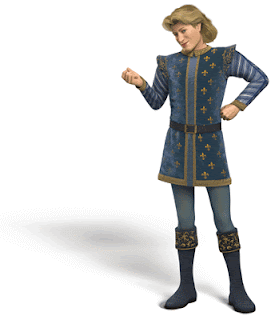
These are not bad things. I like their portrayal in The Sisters Grimm and Fables series, but, as fairy tales often do, they make me wander about the gender roles and amalgamation of characters. What if all the Jacks were separate people, what if there was just one Prince per princess/maiden/heroine? What if "Jack" was a girl, either a female version of the smushed together version, or one girl out of a slew of fellas?
One of the nice things about where my brain is going with this is that it lends itself well to short stories. If you've followed this blog for any length of time, I doubt it's a surprise that short stories are not my forte. I like novels. But the idea of a female Jackie amongst half a dozen other male Jacks is intriguing. I don't know if this thread will make it into the novel that's forming, but I want to write a short story and see how I can play with the gender stereotypes. Not just Jacqueline and Jill went up the hill, or Jackie nimbly jumping over things, but perhaps the most popular Jack finding that beanstalk the next morning, climbing, finding treasures to bring back to her mother, and the subsequent task of killing giants that are trying to kill her.

But for now, like with most of my recent stories, I'm just waiting for a plot to catch up with the characters and premise.
Thursday, October 15, 2009
Went to Writer's Group Yesterday, but This isn't About That
In fact, it's about women. The ladies (and here I imagine Maira Bamford saying, "I'm a lady-ist") of fantasy, books, movies and television.
A couple of months back, Sarah Rees Brennan (author of YA UF 'The Demon's Lexicon') posted about the inequality between male characters and female, opening with the idea "What if Harry Potter were Harriet Potter" and ending around the TV show, 'Supernatural,' about demon-hunting brothers (similar premise to her book), which lacks awesome chicksthat stick around.
Today, Justine Larbalestier (author of YA fantasy, most recently 'Liar' and 'How to Ditch Your Fairy') wrote about some reactions to the female protagonist of 'Liar,' Micah, in her post "On Hating Female Characters." There's this idication that some readers hate female characters more than male characters, or if Char. X is male, his behavior is more acceptable than if Char. X did the same as a female.
Larbalestier mentions some characters--a male would be considered "hot" and desirable to readers, while a female in the same situation is a "slut." In both posts, one of the biggest distinctions seems to be made in how male/female characters deal with romantic/sexual relationships and attraction. One commenter proposes that male protagonists aren't as "depth-y" as female characters, and Harriet Potter would be seen as Mary Sue-ish. Others examine the possibility of female characters being judged more harshly, because they judged in relation to the male characters.
Brennan offers a multitude of examples, how characters might elicit different reactions from readers if genders were reversed (Laurie-->Lori in 'Little Women,' for example), and discusses her own work, with two characters who use their attractiveness to their benefit and the different responses because they're opposite genders.
It's good stuff, and Brennan breaks down the Bechdel test. [Tangent: The Bechdel test is for movies, books, TV, etc., and has three parts--does it have two women; do they talk to each other; about something other than men?--What I find interesting every time I hear about it or see the test mentioned, is that no one ever says exactly what it means when a movie or book fails the Bechdel test. Sure it's bad, and there are bad gender things going on, but people also seem quick to point out, rightly so, that there are good books and movies that fail this test./Tangent]
These posts bring to mind the novel I was editing this summer. It's urban fantasy, with a female protagonist and a number of male and female characters. When I first wrote it, bringing pages to my writer's group in five page chunks (as per our rules), they didn't like her. The group was mostly women and the protagonist was curt, stubborn, and resisting the call to action (IMO), but they saw her as bitchy for no reason. Some of that was learning to be clear about character motivation, but I still feel they were too harsh on her. At the time, my mind kept jumping to the tv show, House. He's grumpy and sarcastic and pushes everyone away, with seemingly even less reason than my protagonist (who had been running away from the fae for years, and pushed people away so as not to bring them to the fae's attention, 'don't get close to them and they can't get hurt'). At least/Especially in the first few seasons.
I ended up softening her character a little bit, but more than changing her behavior, I focused on making her motivations clearer, so her "bitchy" actions wouldn't be dismissed as her being unlikeable. But it jarred me a little, how vehemently they disliked her in the beginning, and it confused me that a male character with similar behavioral ticks was thriving on television (I know I love 'House').
This isn't a romance-related example, but I see this problem that Brennan and Larbalestier point out as cropping up in a variety of situations, not solely romantic. I'm not certain exactly why this is. Larbalestier says she has no resolution, because she actively writes to present females as atheltic and males as fashion-conscious, and break down gender steroetypes, but this perception still seems to show up in people's responses to her books and others'.
I don't have a resolution either, except to make my female characters as three-dimensional as I can, give them believeable motivations and let them exist outside of gender stereotypes -and- outside of their relation to the male characters. (My protagonist for the novel I mentioned has, until this point, avoided dating altogether, and romance is about as far from her radar as anything. I wanted to write an urban fantasy that didn't rely on a romantic subplot.)
I'll leave you all with Brennan's words in the post, because they make me smile and feel good:
"The femme fatales, the ninja ladies, the shy girls, the chatterboxes, the ones several guys wanted, the ones none of the guys wanted, the heroines, the sassy sidekicks, the girl the hero fell in love with in one episode we never saw again, the girl who wanted a guy she didn't get, the girl who was with a ton of different guys, the girl who was devoted to her job, the girl who was into other ladies, the murder victim, the tomboy, the feisty redhead, the dumb blonde. There was never anything wrong with any of them.
"It's worth it to recognise that we're all okay. We were always okay."
A couple of months back, Sarah Rees Brennan (author of YA UF 'The Demon's Lexicon') posted about the inequality between male characters and female, opening with the idea "What if Harry Potter were Harriet Potter" and ending around the TV show, 'Supernatural,' about demon-hunting brothers (similar premise to her book), which lacks awesome chicksthat stick around.
Today, Justine Larbalestier (author of YA fantasy, most recently 'Liar' and 'How to Ditch Your Fairy') wrote about some reactions to the female protagonist of 'Liar,' Micah, in her post "On Hating Female Characters." There's this idication that some readers hate female characters more than male characters, or if Char. X is male, his behavior is more acceptable than if Char. X did the same as a female.
Larbalestier mentions some characters--a male would be considered "hot" and desirable to readers, while a female in the same situation is a "slut." In both posts, one of the biggest distinctions seems to be made in how male/female characters deal with romantic/sexual relationships and attraction. One commenter proposes that male protagonists aren't as "depth-y" as female characters, and Harriet Potter would be seen as Mary Sue-ish. Others examine the possibility of female characters being judged more harshly, because they judged in relation to the male characters.
Brennan offers a multitude of examples, how characters might elicit different reactions from readers if genders were reversed (Laurie-->Lori in 'Little Women,' for example), and discusses her own work, with two characters who use their attractiveness to their benefit and the different responses because they're opposite genders.
It's good stuff, and Brennan breaks down the Bechdel test. [Tangent: The Bechdel test is for movies, books, TV, etc., and has three parts--does it have two women; do they talk to each other; about something other than men?--What I find interesting every time I hear about it or see the test mentioned, is that no one ever says exactly what it means when a movie or book fails the Bechdel test. Sure it's bad, and there are bad gender things going on, but people also seem quick to point out, rightly so, that there are good books and movies that fail this test./Tangent]
These posts bring to mind the novel I was editing this summer. It's urban fantasy, with a female protagonist and a number of male and female characters. When I first wrote it, bringing pages to my writer's group in five page chunks (as per our rules), they didn't like her. The group was mostly women and the protagonist was curt, stubborn, and resisting the call to action (IMO), but they saw her as bitchy for no reason. Some of that was learning to be clear about character motivation, but I still feel they were too harsh on her. At the time, my mind kept jumping to the tv show, House. He's grumpy and sarcastic and pushes everyone away, with seemingly even less reason than my protagonist (who had been running away from the fae for years, and pushed people away so as not to bring them to the fae's attention, 'don't get close to them and they can't get hurt'). At least/Especially in the first few seasons.
I ended up softening her character a little bit, but more than changing her behavior, I focused on making her motivations clearer, so her "bitchy" actions wouldn't be dismissed as her being unlikeable. But it jarred me a little, how vehemently they disliked her in the beginning, and it confused me that a male character with similar behavioral ticks was thriving on television (I know I love 'House').
This isn't a romance-related example, but I see this problem that Brennan and Larbalestier point out as cropping up in a variety of situations, not solely romantic. I'm not certain exactly why this is. Larbalestier says she has no resolution, because she actively writes to present females as atheltic and males as fashion-conscious, and break down gender steroetypes, but this perception still seems to show up in people's responses to her books and others'.
I don't have a resolution either, except to make my female characters as three-dimensional as I can, give them believeable motivations and let them exist outside of gender stereotypes -and- outside of their relation to the male characters. (My protagonist for the novel I mentioned has, until this point, avoided dating altogether, and romance is about as far from her radar as anything. I wanted to write an urban fantasy that didn't rely on a romantic subplot.)
I'll leave you all with Brennan's words in the post, because they make me smile and feel good:
"The femme fatales, the ninja ladies, the shy girls, the chatterboxes, the ones several guys wanted, the ones none of the guys wanted, the heroines, the sassy sidekicks, the girl the hero fell in love with in one episode we never saw again, the girl who wanted a guy she didn't get, the girl who was with a ton of different guys, the girl who was devoted to her job, the girl who was into other ladies, the murder victim, the tomboy, the feisty redhead, the dumb blonde. There was never anything wrong with any of them.
"It's worth it to recognise that we're all okay. We were always okay."
Subscribe to:
Posts (Atom)